The robot looked straight at the casualty, said so out loud — and drove away.
Five runs of our search brain against a simulated rescue scene in Isaac Sim, with a 4B vision-language model as its only eyes. Two of the finds were wrong. This is what it took to make the code believe the camera.
One workstation, one warehouse, one person on the floor
A simulated Nova Carter carries the sensor kit we are building for the real rover. Isaac Sim renders its camera and lidar and publishes them over the ROS 2 bridge; a small node turns the colour stream into MJPEG; llama.cpp serves Gemma 4 E4B with its vision projector; the brain drives through a motor service over TCP. The order is given in Portuguese — “procura uma pessoa deitada com colete refletor” — and nothing else is provided. No map, no waypoints, no detector weights.
flowchart LR
  S["Isaac Sim\nwarehouse, prone worker"] -->|"ROS 2 bridge"| M["MJPEG node\ncolor/image_raw"]
  M --> V["Gemma 4 E4B + mmproj\nthe robot's eyes"]
  V --> B["search skill\ndecides in CODE"]
  B --> T["motor service\nMOVE / TURN / SCAN"]
  T -->|"cmd_vel"| S
The skill is not the model. A deterministic search skill owns the geometry — tiling the field of view, counting coverage, electing and investigating candidates, ending the mission. The 4B model is the executor and the eyes. Whether the target is in view is decided in code, by matching the look's text, because a small model asked to honour a conditional reliably does not.
The model saw it. The matcher did not believe it.
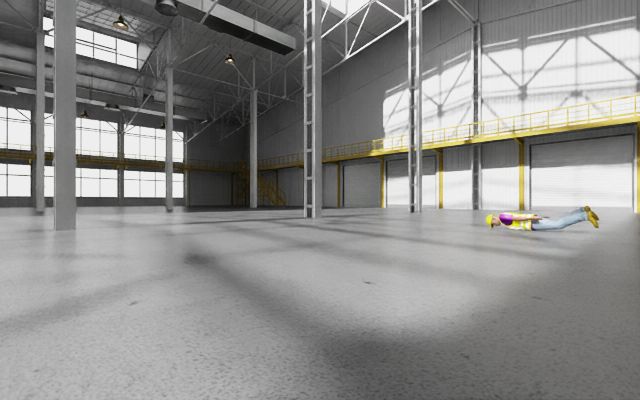
Six looks in, the vision model wrote this, unprompted and correct:
The skill's verdict on that same sentence: not found yet, turn 72° left. Its matcher wants every content word the operator used — pessoa, deitada, colete, refletor — plus a bearing word, in one clause. The model said alguém instead of pessoa and deitado instead of deitada, and gave no bearing at all. Three misses of vocabulary and grammar; zero of perception. The mission ended “não encontrei” with the casualty behind the robot.
Never ask a small model a leading question
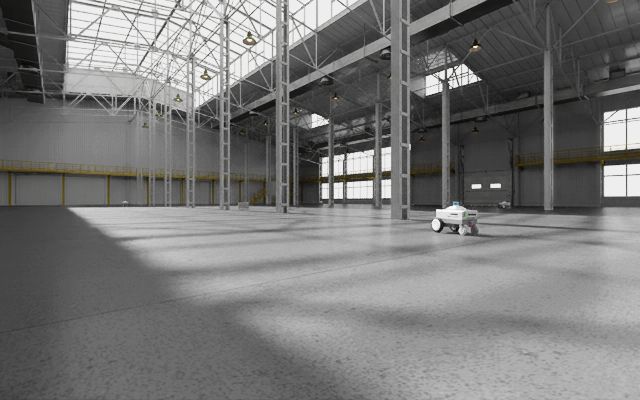
The obvious patch was a second question on the same frame: do you see a person lying down with a reflective vest — left, centre, right, or no? With the second rover parked in the hall, the model answered esquerda, then direita, then centro. The mission ended FOUND, facing a robot. A 4B model asked a yes/no question about a target leans toward yes, and any code that treats that yes as a sighting will close missions on the wrong object.
Make the model name what it sees, then face it
Two changes, both now in the brain. First, the second question is structured, and a yes only counts when the model names something that is not a robot, vehicle or machine:
An accepted answer is appended to the look as a clause in the operator's own words — “; uma pessoa deitada com colete refletor à frente” — which is exactly what the matcher was built to read. Parsing is deliberately conservative: a bare sim without a side is not actionable. A miss costs one more sweep look; a false positive ends the mission facing the wrong thing.
Second, a confirmed sighting that sits to one side now earns a 20° centring nudge instead of the next blind tiling turn — in run 2 the 72° step overshot past a person the camera had just placed on the left. Two smaller repairs ride along: floor words describe where, not what, so an empty floor can no longer be a match, and Portuguese gender and number endings now match each other.
Five runs, two of them wrong
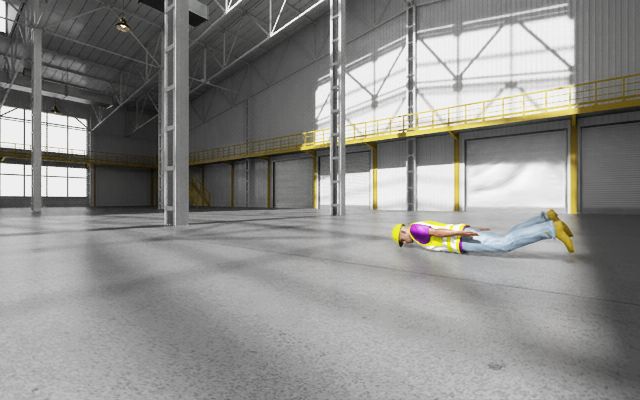
Counted honestly: looks · turns · wall-clock, and “found” only counts when a human checked the frame at the final heading. Two of the three “found” verdicts before the fix do not survive that check.
We stopped trusting the model to score itself
To know where the person actually was, the rover turned a full circle in 30° steps and kept one frame per stop. The panorama put the casualty at −87° and −50°, matching the odometry prediction — and exposing run 3's confident cues as hallucinations. A model cannot be both the instrument and the reference.

Two findings that survive the trip to hardware
Turns coast. The service ends a turn when integrated heading reaches target; the chassis keeps rotating 10 to 13° after that. Five commanded 72° steps produced 412°, so a tiling sweep sized to a 90° camera cone quietly opens gaps. Either the service stops early by the predicted coast, or the step shrinks.
A 2D lidar cannot see a lying person. The scan plane sits at 0.66 m; a prone body is under 0.5 m. Any approach that ranges the target with lidar measures the wall behind the casualty and drives through the person it was sent to help. Ranging a prone target has to come from the camera or the sonar — which is now a hardware requirement, discovered for free, in a simulation, before anyone was standing in front of the robot.
Five rules for putting a small VLM in a control loop
1. If a policy decides in code, give it code-shaped evidence. Free description is for the operator; the policy needs a schema, and one structured question per frame is cheap. 2. Never ask a small model a leading yes/no about the target — make it name what it sees, then veto. 3. Keep the operator's words as the contract, so matching is about their intent rather than the model's vocabulary. 4. A confirmed sighting is a steering input: policies tuned against perfect simulated oracles will sweep past real, off-centre targets unless facing is an explicit step. 5. Verify a find against the frame, never against the transcript.
Limits, stated plainly: one scene, one target, one model, n = 5. The contribution is the failure taxonomy and the shape of the fix, not a benchmark. Next: the same loop on the metal rover, a COCO person detector riding the same frame as a third eye, and camera-based ranging for targets the lidar plane misses.